There's no such thing as a safe tan. Here's what's happening underneath your summer glow
- Written by: H. Peter Soyer, Professor of Dermatology, The University of Queensland
There’s a lot to be said for sunshine – both good and bad. It’s our main source of vitamin D, which is essential for bone and muscle health. Populations with higher levels of sun exposure also have better blood pressure and mood levels, and fewer autoimmune diseases such as multiple sclerosis.
On the other hand, excess UV exposure is estimated to contribute to 95% of melanomas and 99% of non-melanoma skin cancers. These skin cancers account for a whopping 80% of all new cancers each year in Australia.
Like any medicine, the dose counts. And in Australia, particularly in the summer, our dose of UV is so high that even short incidental exposures – like while you hang out the washing or walk from your carpark into the shops – adds up to huge lifetime doses.
Fortunately, when it comes to tanning, the advice is clear: don’t. A UV dose that’s high enough to induce a tan is already much higher than the dose needed for vitamin D production. A four-year-long study of 1,113 people in Nambour, Queensland, found no difference in vitamin D levels between sunscreen users and sunscreen avoiders.
Read more: Monday's medical myth: we’re not getting enough sun
What’s happening in the skin when I get a tan?
A tan forms when ultraviolet (UV) rays from the sun discharge too much energy into our skin, causing damage to membranes, proteins, and most importantly, DNA. The excess energy of UVB rays (part of the UV ray that penetrates the upper layers of our skin) prevents the DNA from copying correctly when the cells multiply which can cause mutations.
UVA rays which penetrate deeper into the skin can trigger a reactive and harmful process (known as oxidative free radical damage) which can damage not just DNA but also many of the skin’s structural components. It’s been estimated a single day’s sun exposure can cause up to a million DNA defects in each skin cell.
Excess energy from UVB rays causes DNA bases to link up incorrectly, making it difficult to copy accurately and leading to mutations that can cause cancer. NASA/David HerringOnce their DNA repair mechanisms detect large amounts of damage, skin cells signal pigment-producing cells (melanocytes) to start producing extra melanin, the pigment that gives our skin, hair and eyes their colour.
The extra melanin is parcelled up and transported into other skin cells to settle over and protect the part of the cell containing the DNA. This filters some UV rays and gives tanned skin its brown colour. But this tan doesn’t provide much help – it’s only as protective as SPF 2 sunscreen.
Read more: Explainer: what happens to your skin when you get sunburnt?
Wrinkles, blotches and broken capillaries
Two in three Australians will develop a skin cancer in their lifetime, mostly thanks to the DNA damage caused by UVB rays. But premature ageing is a less well-known effect of too much sun exposure.
UVA rays penetrate deep into the dermis, the lower layer of the skin, and generate reactive oxygen that damages the skin’s structures. Over time this causes solar elastosis, where irregularly thickened clumps of elastic fibres form, then degrade into disorganised, tangled structures.
This 70-year-old has deep wrinkling and skin darkening caused by long-term sun exposure on her neck and part of her chest exposed by her shirt, while the rest of her skin has stayed relatively clear and unwrinkled. Author providedEventually this can take the form of roughening or leathery appearance, deep wrinkling, dark blotches and star-shaped white patches, and an overall yellowish tone. Prematurely-aged skin is often more easily-bruised or has broken capillaries.
Dark blotches and white scar-like patches are common signs of ageing caused by too much sun. DermNetNZ.orgBut I like the way a tan looks. What now?
It’s well known that a tanned look seems healthy and attractive to many Australians. Recent research shows Australians who feel particularly self-conscious about their body are more likely to intentionally tan to increase their sense of attractiveness.
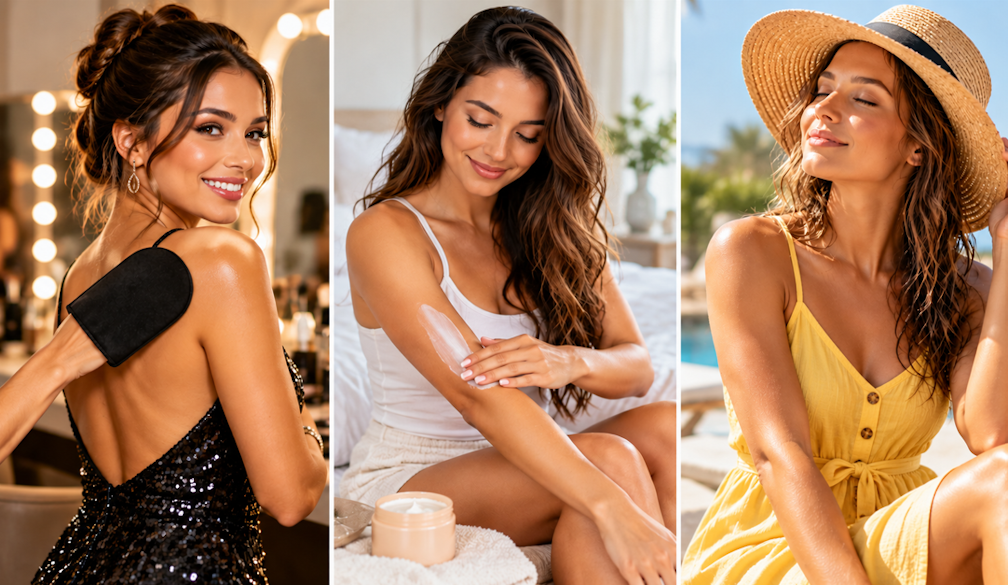
Fortunately, there’s a safe way to indulge in the aesthetics of golden-brown skin: any tan that comes out of a bottle with the active ingredient dihydroxyacetone. This is a colourless sugar molecule that turns brown when it reacts with amino acids in the skin. It’s safe to use because it doesn’t penetrate deeper than the very top layer of skin, where the cells are already dead.
Don’t be tempted by solariums and sunbeds, because they emit up to six times as much UV as the midday summer sun. Commercial solariums are illegal in Australia for this reason, but there are still privately-owned sunbeds in use. Avoid them at all costs.
Read more: How do the chemicals in sunscreen protect our skin from damage?
So how do I stay sun safe without living in a cave?
There are two parts to sunsafe behaviour in Australia that lets you get the health benefits of sunshine and prevents you from being one of the 2.4 million Aussies getting sunburnt each weekend.
First, you should wear 30+ SPF sunscreen every day when the UV index in your area is three or higher. By putting it on everywhere that isn’t covered by that day’s outfit, you protect yourself from the damage accumulated by short exposures, day in and day out, in Australia’s intense UV environment.
You should make sunscreen part of your morning routine, like brushing your teeth. Use the Cancer Council’s free Sun Smart app or check your local weather report to find out the UV index where you are today.
During the cooler months in southern parts of Australia, when the UV index is often below three, it’s good to spend some time on most days, in the middle of the day, with skin exposed to the sun to maintain healthy vitamin D levels.
So, a lunchtime stroll with your sleeves rolled up is a good idea in July in Hobart, where the UV index only gets up to one. In Brisbane at the same time, with an average July UV index of four, you don’t need to take special steps to get enough vitamin D.
Second, if you’re planning to be outside for a prolonged time, you should follow the Slip Slop Slap Seek Slide advice. Slip on a long-sleeved shirt, slop on sunscreen, slap on a hat, seek shade and slide on some sunglasses. Reapply your sunscreen every two hours, and be sure to use plenty: you want about a teaspoon each for your back, chest, head/neck, and each arm and leg.
H. Peter Soyer is a consultant for Canfield Scientific Inc, MoleMap NZ Limited, e-derm consult GmbH, and First Derm, and is a shareholder in MoleMap NZ and e-derm GmbH. He receives funding from the National Health and Medical Research Council.
Katie Lee does not work for, consult, own shares in or receive funding from any company or organisation that would benefit from this article, and has disclosed no relevant affiliations beyond their academic appointment.
Authors: H. Peter Soyer, Professor of Dermatology, The University of Queensland