Why We Trust What Other People Already Like: Social Proof in the Age of Instagram
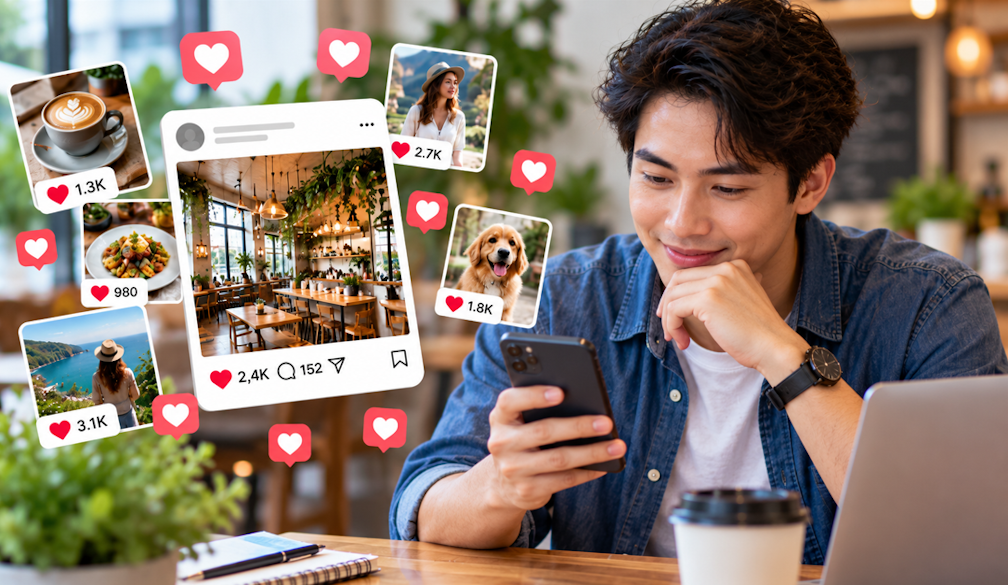
Long before you read a caption or inspect an image, you have already processed the number sitting underneath the post.
Forty likes and 12,000 likes create two entirely different first impressions, even if the content itself is absolutely identical. That reaction isn't particularly rational, nor is it irrational. It is simply a psychological shortcut our brains use to quickly decide what deserves our limited attention.
On Instagram, likes turn that invisible shortcut into a highly visible metric.
Why Popularity Changes the Way We See a Post
Social proof becomes incredibly powerful when we don't have enough information to make a decision on our own. If thousands of other people appear to approve of something, their collective approval becomes a new, highly influential piece of information.
This doesn't mean people consciously look at a screen and think, “12,000 users liked this, therefore it must be objectively good.” The psychological effect is much subtler. A popular post simply looks worth stopping for. A new product feels oddly familiar before you even know what it does. An unknown brand feels significantly less risky when a crowd of other people already seem to be paying attention to it.
Academic research on Instagram behavior backs this up. A study of 260 Instagram users found that post popularity and the quality of the argument both contributed to trust in branded Instagram content, which directly translated to more positive attitudes toward the product. Popularity didn't replace the need for substance, but it served as a powerful cue that people used when initially judging the post.
Another study focusing specifically on social media advertising found that ads displaying a higher number of likes were perceived as more credible, which subsequently contributed to much more favorable attitudes toward the advertised brand.
This aligns closely with what psychologists call the bandwagon effect. Once something appears popular, joining the existing response feels safer and easier. The popularity itself starts carrying its own weight as information.
Likes are particularly brilliant at triggering this effect because they require zero cognitive load to understand. You don't need to read fifty detailed reviews or analyze why every single person clicked the heart. The consensus is summarized in one clean number.
The Brain Responds to Likes as Social Information
One of the most fascinating experiments on Instagram behavior went far beyond asking people how they felt on a survey. Researchers put participants inside an fMRI scanner and showed them photographs within an interface designed to mimic Instagram.
The study involved 61 teenagers and young adults aged 13 to 21. Some images appeared with many likes, while others had very few.
The results were striking. Participants were significantly more likely to "like" photographs that already appeared popular. More importantly, when they looked at highly liked images, researchers observed greater activity in several brain regions, including the nucleus accumbens—a key hub in the brain’s reward circuitry.
In other words, witnessing the visible approval of other people wasn't just a behavioral nudge; it triggered a measurable neural response.
This was not an isolated finding. A recent systematic review analyzed 11 neuroimaging studies featuring a total of 504 participants. It found that positive social feedback in the form of likes was repeatedly associated with heightened activity in regions involved in reward processing and social evaluation, including both the nucleus accumbens and the ventromedial prefrontal cortex. The review also noted behavioral evidence proving that this positive feedback directly affects subsequent social interactions.
This neuroscience explains why a like count carries so much weight, even when no one consciously treats it as serious evidence. Social approval is not processed like a line item on a spreadsheet. It is a primal social cue deeply tied to our brain's reward system.
Likes Can Influence More Than Attention
This effect becomes especially critical when applied to e-commerce and consumer products.
A 2025 study combined two controlled experiments with real-world social media data to examine the impact of likes on consumption-related content. The researchers discovered that higher like counts could strengthen a user's intention to repurchase and generate positive word of mouth by satisfying a deep psychological need for social acceptance (though the effect varied depending on how closely the product matched the user’s ideal social identity).
Research focusing on short-form video commerce points in the exact same direction. A separate 2025 study concluded that the quantity of visible social proof—including both likes and comments—had a direct, positive effect on impulse-buying responses.
None of this means that consumers are mindless drones who automatically buy whatever has the biggest number underneath it. A heavily liked bad product will ultimately remain a bad product.
What the number can change is the starting position.
Instead of encountering an unknown post with zero context, the viewer encounters something that has apparently already been vetted and approved by a crowd. That subtle shift makes the content easier to notice, easier to explore, and, under the right circumstances, easier to trust.
Comments and follower counts add deeper layers of context, but likes are unusually efficient because they compress thousands of tiny, individual reactions into one number that can be absorbed in a fraction of a second.
Why Brands Care About the First Visible Number
For brands and creators, this psychological reality creates a very practical problem: every new post starts at zero.
A brilliant product launch can look awkwardly quiet in its first few hours simply because the bulk of the organic audience hasn't logged on to see it yet. The quality of the content hasn't changed, but the visible social proof around it is missing.
That cold-start problem is exactly why brands sometimes choose to inject engagement into selected, high-priority posts. Services offering Instagram likes can increase the visible count early on, giving the post a much stronger baseline while organic reactions naturally develop.
However, both the amount and the quality of that engagement matter deeply.
A believable increase that broadly fits the size and normal activity of an account creates a reassuring first impression. An absurd, sudden jump that makes the surrounding profile look entirely inconsistent does the exact opposite. Furthermore, likes coming from obviously weak or suspicious-looking accounts actively work against the social proof the brand was trying to create.
When used carefully, the strategic value of additional likes is straightforward: they strengthen a psychological cue people already notice and already use when forming their first impressions.
They do not prove that a product works. They cannot replace great creative direction, useful information, or a stellar customer experience. And psychology certainly does not support the idea that people will blindly hand over their money to the biggest number on the screen.
But the data proves something much more interesting: visible popularity can change what gets our attention, how credible something initially feels, and even how our brains light up in response to the content in front of us.
That is a tremendous amount of influence for a tiny heart and a number beside it.
Research and Further Reading
-
The Power of the Like: How Visible Likes Affect Neural and Behavioral Responses on Instagram
https://pubmed.ncbi.nlm.nih.gov/27247125/ -
How Like Counts Influence Trust in Social Media Advertising
https://doi.org/10.1108/EJM-11-2017-0883 -
How Instagram Post Popularity and Argument Quality Build Consumer Trust
https://doi.org/10.1016/j.elerap.2020.100998 -
Instagram Advertising, Follower Counts, and Brain Responses to Persuasion
https://doi.org/10.1108/EJM-09-2020-0719 -
How Post Popularity Increases the Credibility of Sponsored Instagram Content
https://doi.org/10.1080/20932685.2025.2491310 -
How Large Numbers of Likes Affect Brand Credibility and Social Value
https://doi.org/10.1016/j.actpsy.2026.106927