The Loading Mistake That Has Nothing to Do With How You Drive
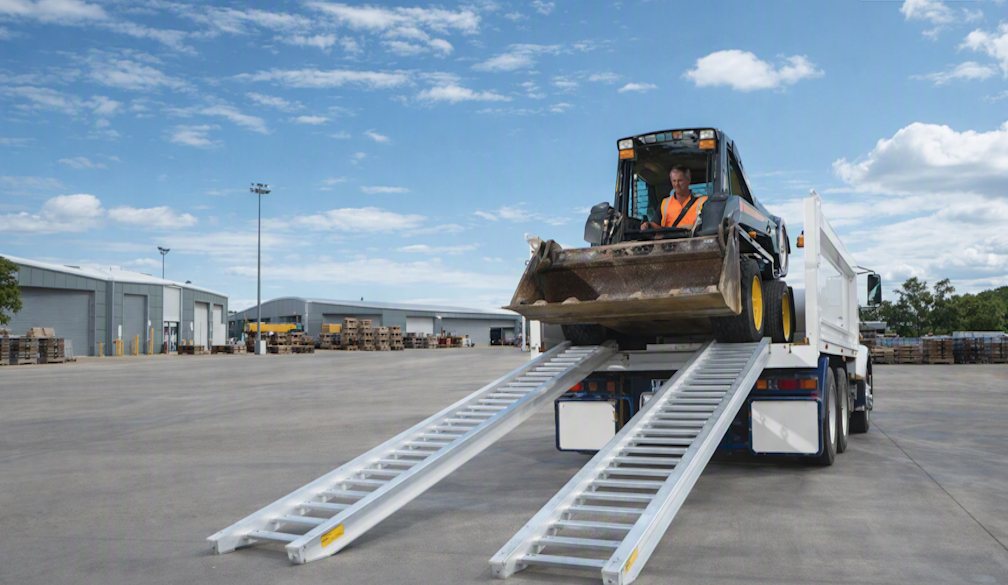
The mower made it three-quarters of the way up before the front wheels went light.
I watched it happen in a hire yard outside Wangaratta: a bloke reversing a ride-on up a pair of short ramps onto a box trailer, tray maybe 600mm off the ground, ramps that looked plenty long enough. He gave it a touch more throttle to clear the lip. The nose lifted, the weight slid to the back axle, and the whole machine hung there for a second, deciding which way to go.
It chose the ground.
He was a good operator. That was the unsettling part. Nothing about his hands on the controls caused it. The ramp did.
Here is the claim most people loading machinery have never sat with: the vehicle is almost never the reason a load goes wrong. The angle is. A loading accident is a maths problem dressed up as a confidence problem, and the maths is usually decided before the engine even starts.
The 10-second version
- Ramp angle is arithmetic, not a feeling: deck height ÷ ramp length gives you the climb.
- Your machine's slope rating is lower than you think. A short ramp quietly exceeds it.
- Sideways tip is only half the danger. The other half is grounding out at the transition.
- Length is the fix. Double the ramp, roughly halve the angle.
- Run the number before the throttle, every time.
Why is the ramp steeper than it looks
Ramp angle is not a feeling. It is arithmetic you can do in the shed.
Take the height of your deck, divide it by the length of the ramp, and you have the sine of the angle the machine has to climb. The trouble is that the human eye is a terrible protractor. A ramp always looks gentler than it is.
Run a few honest numbers, and it gets uncomfortable fast.
|
Deck height |
Ramp length |
Actual angle |
|
600 mm |
3.0 m |
~11.5° |
|
600 mm |
2.0 m |
~17.5° |
|
900 mm (ute tray) |
2.4 m |
~22° |
|
900 mm |
2.0 m |
~27° |
That last row is a wall you are asking a machine to drive up.
Notice the pattern. The taller the deck and the shorter the ramp, the more punishing the climb, in a curve that steepens far quicker than instinct expects. This is exactly why a ramp angle calculator, even the back-of-a-diary kind, beats a glance every single time.
Your machine is rated for a slope. The ramp ignores it.
Every serious piece of mobile equipment has a slope limit, and it is lower than people assume.
STIHL advises that a ride-on mower should not work on a gradient steeper than 10 degrees (17.6%) for safety, because beyond that the tipping risk climbs sharply. Many operator manuals cap basic ride-on use at around 15 degrees.
Now look back at the table. A 600mm deck with a 2-metre ramp puts that same mower on a 17.5-degree climb. You have quietly asked the machine to exceed its own tipping threshold for the ten seconds it is least stable and most loaded.
This is not a fringe concern. OSHA's guidance on riding mowers names loading ramps directly as a roll-over risk location, alongside slopes, wet surfaces, and drop-offs, and recommends avoiding anything steeper than 15 degrees where no manufacturer figure is available.
The ramp is not a neutral bridge to the trailer. It is the steepest slope your machine will meet all day.
Sideways is not the only way it goes wrong
Ask someone to picture a loading accident, and they picture a tip to the side. Half the real ones are something else entirely: the belly-out.
I once watched a two-tonne excavator strand itself loading onto a plant trailer. The average ramp angle was fine. The problem was the transition, the sharp break where the ramp meets the tray. As the machine crested it, the undercarriage grounded on the lip, the tracks lifted just enough to lose grip, and it sat there see-sawing on its own belly with both ends light.
Nothing tipped. Nothing needed to. It simply stopped being a machine that could move and became 2,000 kilograms of awkward.
That break point is called the breakover, and low-slung gear (mini excavators, scissor lifts, slammed trailers) is chronically caught by it. A ramp can pass the "average angle" test and still ambush a machine at the two joints that matter: where it meets the ground, and where it meets the deck.
Average angle is the headline. The transitions are the fine print, and the fine print is what grounds you.
Length is the fix, and it is what people cheap out on
Here is the mechanical good news. Angle has a lever, and the lever is length.
Double the ramp, and you roughly halve the steepness. That 27-degree wall to a ute tray drops under 15 degrees the moment the ramp gets past about 3.5 metres.
So why does nobody carry the longer ramp? Weight. A long steel ramp is a two-person, wrench-your-back item, so people default to the shortest set they can get away with, which is precisely the wrong optimisation.
This is the one place where the material genuinely changes behaviour. Purpose-built aluminium ramps give you the extra metre of length without the extra dead weight, which means the safe-angle option is also the one you will actually bother to use. A ramp that is correct but too heavy to lift is a ramp that stays in the shed while you make do with the short one.
Buy for your tallest deck and your lowest machine, not for the easy average. The ramp that suits the ute tray will always suit the trailer. It never works the other way around.
The task you rehearse least is performed at your worst
Think about when loading actually happens. End of the job. Light going. Everyone tired and keen to get home. The ute parked on a slope in a paddock, so the ramp feet sit on soft, uneven ground that adds its own hidden angle before the machine even climbs.
That is the real risk profile. Loading is the operation people practise least and perform in the worst conditions, and it is over in seconds, so the pressure to "just send it" is enormous.
The fix is unglamorous. Treat loading as its own job with its own short routine:
- Level the ute or trailer first. A tilt in the base adds straight onto the ramp angle.
- Check what the ramp feet are standing on. Soft or sloped ground changes the number.
- Know your deck height and your machine's slope rating as fixed figures, not vibes.
- Run the ramp angle calculator once, then paint the safe minimum ramp length on the trailer so you never guess again.
- Load in the up-and-down line only.
Never let a machine sit across the slope of a ramp.
None of that requires being braver on the ramp. It requires being boring in the shed.
The last ten seconds
The safest operators I have met are not the ones who charge the ramp with the most conviction. They are the ones who already did the arithmetic before they climbed in, so the ramp held no surprises.
The wrong angle takes ten seconds to calculate and a very long time to walk back from.
Next time, before the throttle, do the ten seconds.
Frequently asked questions
How do you calculate a loading ramp angle?
Divide the deck height by the ramp length, then take the inverse sine (arcsin) of that number. A 600mm deck with a 2-metre ramp works out to roughly 17.5 degrees. If you would rather not do the trigonometry, a ramp angle calculator gives you the figure in seconds from the same two measurements.
What is a safe angle for loading a ride-on mower or machine?
Use the machine's own slope rating as your ceiling. Many ride-on mowers are rated around 10 to 15 degrees, and OSHA advises avoiding anything steeper than 15 degrees when no manufacturer figure is available. If your ramp angle exceeds that number, the ramp is too short for that deck.
How long should a loading ramp be?
Long enough to keep the climb under your machine's slope rating for your tallest deck. As a rule of thumb, a 600mm trailer deck wants a ramp of at least 2.5 to 3 metres, and a 900mm ute tray needs to get past about 3.5 metres to stay under 15 degrees. Longer is safer, because length is what tames the angle.
Why do machines tip or get stuck on a loading ramp?
Two reasons. The first is exceeding the machine's slope rating, which lifts the front and shifts weight to the rear until it tips. The second is the breakover, where a low machine grounds out on its belly at the sharp point where the ramp meets the deck, losing traction even though nothing has tipped.
Are aluminium ramps safer than steel?
Not because of the metal itself, but because of behaviour. Aluminium ramps are light enough to carry in the correct, longer length without a two-person lift, so people actually use the safe-angle ramp instead of defaulting to a short one that is easier to handle.