Why a Child's Foot Is Meant to Change Shape as They Grow
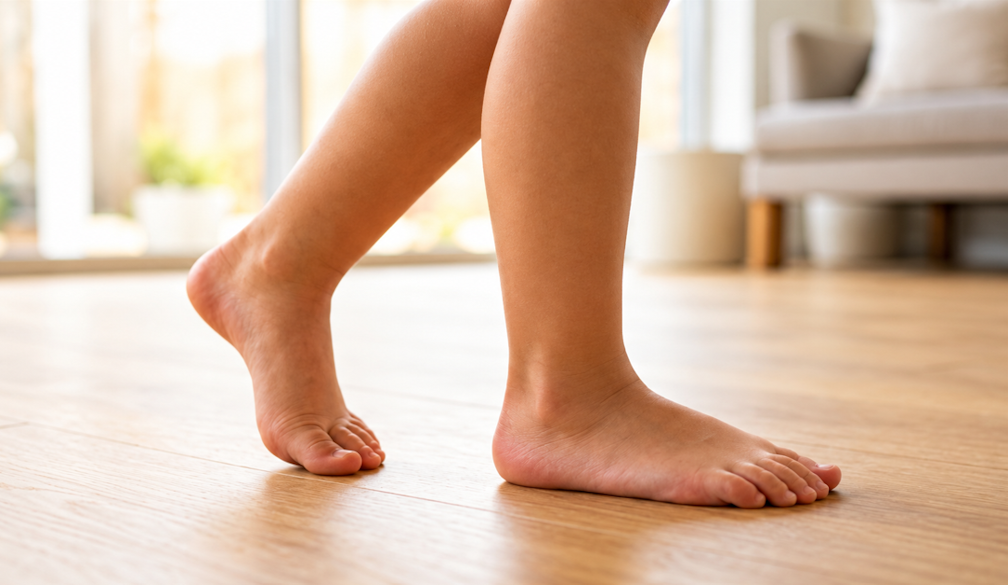
Most children under three have flat feet, and most develop an arch by around age six, according to the Royal Children's Hospital in Melbourne. That timetable surprises plenty of parents, who often notice a flat foot at two or three and wonder whether something has gone wrong. In most cases, nothing has. A child's foot is not a small adult foot, and several of its changes happen on a schedule that has little to do with footwear or how much a child runs around.
The Early Years: Flat Is the Starting Point
In toddlers, a flat appearance is the normal baseline rather than a problem waiting to be spotted. The arch builds gradually through early childhood, and children vary in how quickly it shows. Clinicians separate a flexible foot from a rigid one. In a flexible foot, the arch appears when the child rises onto their tiptoes or sits with their feet off the ground. A rigid foot keeps its flat shape in those positions. The Royal Children's Hospital states that painless, flexible flat feet require no treatment, and that orthotics do not help form an arch and are not recommended for them.
That last point is worth knowing, because shoe inserts are often marketed to parents of young children as if they could guide an arch into shape. The published guidance from a major children's hospital does not support using them that way for a painless, flexible foot. Flat feet can still be worth a closer look, and the reason for looking matters more than the shape itself.
When a Clinician Looks Further
The same guidance lists the situations where a flat foot is referred for assessment: a rigid foot, a painful foot, one foot looking different from the other, tenderness in one specific spot, or difficulty with activities such as running and jumping. Shape on its own is not on that list. Pain, asymmetry and trouble with movement are.
For families in that position, an assessment with a paediatric podiatrist Brisbane families can book directly is one way to have a child's structure, strength and movement looked at together, rather than relying on how the foot appears when standing still. A parent watching from the sideline can see that a child is slower or more hesitant than peers. Working out whether that traces back to the foot, the hips, general coordination or something else entirely is a question for a trained practitioner, and a GP is a reasonable first stop if a family is unsure where to start.
The School Years: Growth Plates and Heel Pain
A different set of changes arrives later. At the back of the heel, the growth area where the Achilles tendon attaches to the heel bone is still turning from cartilage into bone during the school years. Better Health Channel, the Victorian Government's health information service, describes Sever's disease as a condition of this growth area, most commonly affecting children between about eight and 14. Running and jumping sports such as football, netball and gymnastics are linked to symptoms, as are growth spurts and sudden increases in training.
Better Health Channel describes the condition as one that resolves without treatment and rarely causes long-term problems, though flare-ups can continue until the growth area matures, which can take about two years or longer. A doctor or allied health professional such as a podiatrist, physiotherapist or orthotist can diagnose it from symptoms and a physical examination. Imaging is only sometimes needed to rule out other causes of heel pain.
Heel pain in a growing child who plays a lot of sport therefore has a recognised, usually self-limiting explanation. Even so, a diagnosis is made by examination, not assumed from age and activity alone, which is why a persistent or worsening complaint is worth having looked at by a doctor or allied health professional.
A Schedule, Not a Verdict
Seen together, these changes describe a foot that is meant to look and feel different at each stage of childhood. Most of the variation between children is part of normal development, and the guidance from children's hospitals leans towards reassurance for painless, flexible feet. The questions that deserve professional attention are the ones about pain, asymmetry and difficulty with everyday movement, not whether a child's arch looks the way an adult's does.